When Tyler Davidson’s new horror-comedy Buddy opens in 1,000 theaters nationwide on Aug. 28, much of what audiences see will have been made possible by a rapidly expanding production operation outside Cleveland.
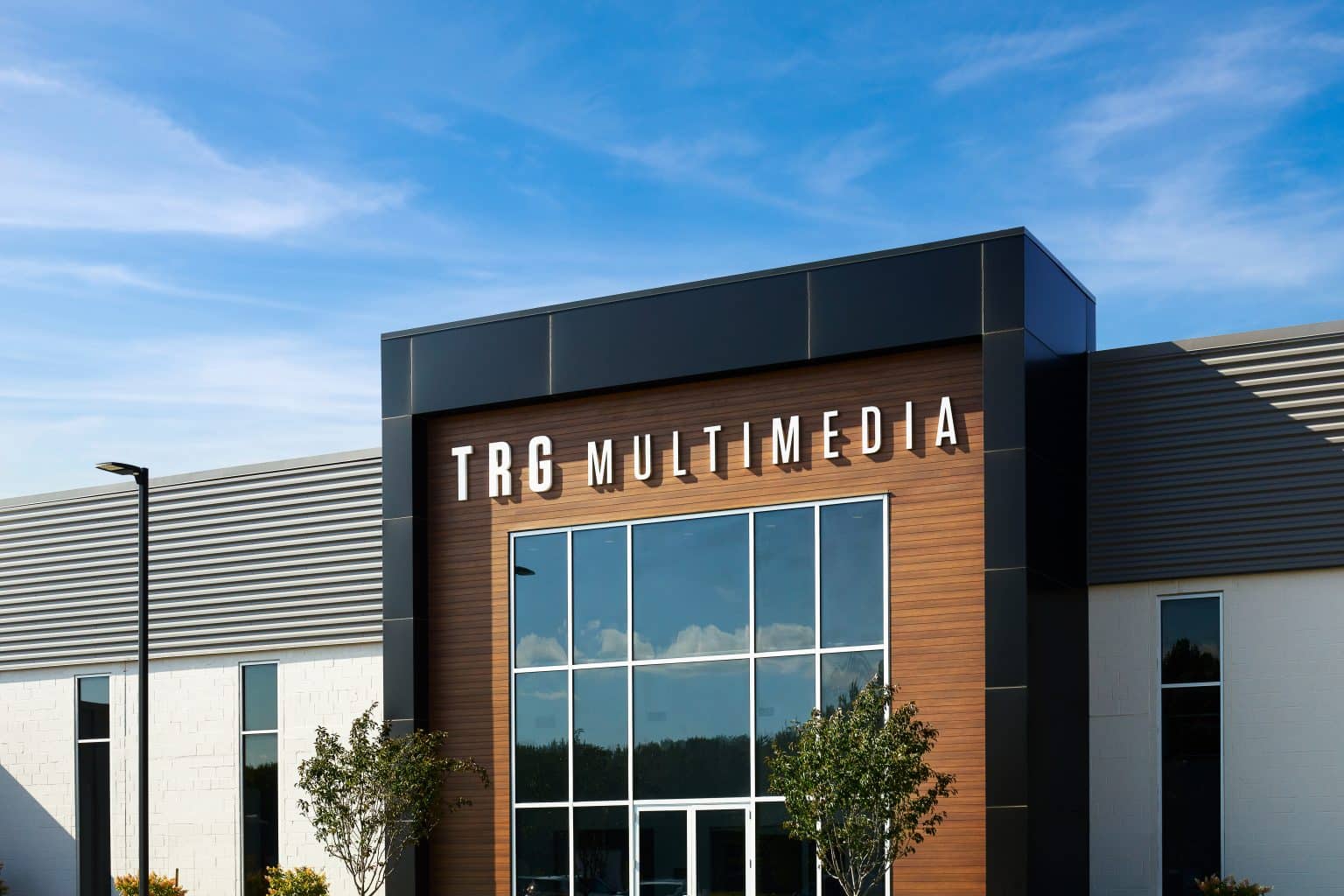
TRG Multimedia, which served as an executive producer on the film, provided the infrastructure that allowed Davidson and his team to shoot approximately 85 percent of the feature in Northeast Ohio. The Brooklyn, Ohio-based company occupies 160,000 square feet of the former American Greetings headquarters, where it has assembled one of the region’s most extensive film, television and commercial production facilities.
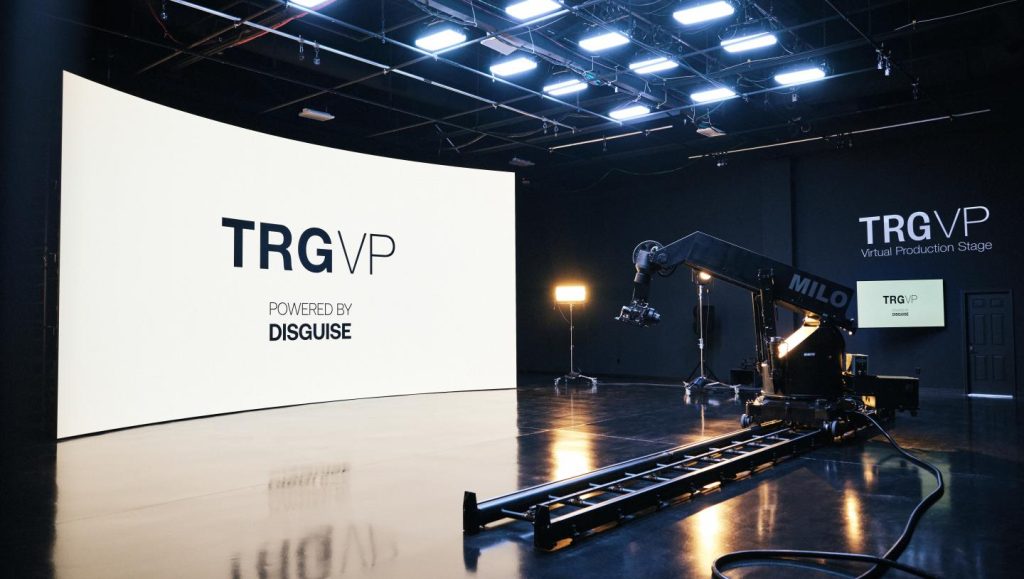
The company’s TRG Sound & Vision division includes a 30,000-square-foot soundstage, a 10,000-square-foot virtual production wall and a 40-by-60-foot cyclorama wall. Its technology arsenal also includes a Milo motion-control camera robot and sensor system.
“We also have a Milo motion-control robot and sensor system, so we have all of these tools that are very appetizing to film producers all over the country,” said TRG CEO and president Adam Wilde.
Founded in 1983 as The Rueben Group, TRG relocated to the 80,000-square-foot former American Greetings facility in 2019. It has since expanded three times, doubling its footprint to 160,000 square feet. Wilde, who joined the company in 2003, acquired it from founder Martin Rueben in 2023.
The arrival of Buddy represents a significant test of TRG’s ambitions to become both a full-service production destination and a home for original film and television development in Ohio.
Directed by Too Many Cooks creator Casper Kelly, Buddy stars Topher Grace, Cristin Milioti, Patton Oswalt and Delaney Quinn in a surreal send-up of 1990s children’s television. Keegan-Michael Key voices the movie’s bright orange unicorn mascot, a seemingly cheerful children’s character who becomes terrifying when his young audience refuses to participate. Michael Shannon voices additional characters inhabiting the film’s increasingly unhinged television universe.
Davidson produced and co-financed the film through his Cleveland-based company Low Spark Films. The Chagrin Falls native said TRG filled a longstanding gap in Northeast Ohio’s production ecosystem by providing enough stage space and technical infrastructure to accommodate a feature of this scale.
“I’ve been making films here for a long time,” Davidson said. “The missing link that’s always discussed is do we have that kind of infrastructure to post features of a larger scale that require that kind of space, and TRG’s massive studio is the answer to that.”
The production required a substantial facility where the filmmakers could construct and photograph the different worlds contained within the story. Davidson was familiar with TRG executives Geoff Yaw and Ryan Kelly but had not met Wilde before arranging a tour of the property.
“I set up a tour and a meeting and was so impressed with what they had and pitched them on the project and thought there might be a way to work together,” Davidson recalled. “To my delight, it was perfect timing because they were looking to launch their new feature film division Substance at that same time, so it really was a no-brainer to find a way to collaborate.”
Davidson believes the facility could open new possibilities for filmmakers based in Ohio while also giving incoming productions more reasons to remain in the state.
“Productions that are either homegrown or coming in from outside of the area should definitely pay attention to what’s going on there and what’s offered there because it opens a lot of possibilities,” he said.
Building an Original Content Business
TRG launched Substance three years ago as a film and television division focused on developing original material alongside projects brought to the facility by outside producers. Wilde operates the division with co-founders Yaw, its head of development, and Kelly, its head of creative.
Its growing slate includes Wilde’s feature documentary Slowburn Shoot: An Indie Wrestling Story, which premiered April 13at the 2026 Cleveland International Film Festival and will screen Sept. 3 at the Cleveland Institute of Art Cinematheque.
The 82-minute film explores Cleveland-based Absolute Intense Wrestling, an independent promotion that has become an important proving ground for performers hoping to advance to major organizations such as WWE.
“We’re telling very human stories within the wrestling world, and we’re telling stories of people trying to break into the wrestling world and trying to compete at the top level,” Wilde said. “We’re also talking about guys who have been on the independent circuit for 25+ years, and they’re looking to end their careers.”
WWE performer Johnny Gargano is among the Cleveland wrestlers featured in the documentary. Gargano rose through AIW before moving into the international spotlight with WWE.
“AIW is one of the last checkmarks on an independent wrestler’s resume before they try to launch themselves up to the WWE,” Wilde said. “It’s interesting that it’s in our backyard, but it’s this unknown entity that is really special and serves like a farm league in baseball, so they’ve got a lot of the talent.”
The documentary’s title combines two pieces of wrestling terminology: A “slow burn” describes storytelling that unfolds over time, while a “shoot” refers to something real rather than scripted.
“A ‘slow burn’ is patient storytelling, and a ‘shoot’ is something that’s real,” Wilde explained. “The film explores the real lives behind the stories being told in the ring.”
What began as Wilde’s personal photography project grew into seven years of filming. He ultimately shaped the documentary from approximately 70 hours of footage, following wrestlers at different points in their careers and examining the relationships behind AIW’s carefully choreographed confrontations.
Among the film’s central figures is Joshua Piscura, an AIW wrestler who retired at 45 after competing since he was 19. Wilde’s team followed Piscura during the final day of his wrestling career in May 2024, filming him at Independence High School, where he teaches government and psychology, at home with his family and later at the Cleveland Masonic Performing Arts Center for his final match.
“Adam and his crew did a nice job and were gracious with how they presented me, how they followed me for the last day or so, and it’s such a nice thing to have to show, hopefully, my grandkids down the road and just to have that as a keepsake,” Piscura said.
“It was a cool way to commemorate what for me was a big deal, closing that chapter of my life, which wasn’t easy because I still loved wrestling but as I got older, it was harder to stay in the shape that you need to stay in and it’s easier to get injured,” he added.
AIW founder and owner John Thorne said the documentary resisted the temptation to sensationalize the wrestling business or the lives of its performers.
“Adam remained true to how we operate as a business and how we interact with each other. It’s not a salacious, ‘gotcha’ documentary. It showcases exactly what we are as a company and the interesting subculture of people that is independent wrestling, and it’s never really been captured in the way that Adam was able to do it,” Thorne said.
“Cleveland can be a heartbreaking town, and the story of AIW has been one of resilience that Cleveland sports fans can relate to – struggling through setbacks and trying to achieve a common goal,” Piscura added. “Another thing that comes through with the documentary is the sense of family amongst the guys and the people that are part of the wrestling promotion and how deep those relationships are.”
Following Buddy’s theatrical opening, Wilde will take Slowburn Shoot to London for a screening at the Prince Charles Cinema in the West End, timed to coincide with All Elite Wrestling’s All In event at Wembley Stadium.
Substance Expands Its Slate
Substance’s upcoming projects extend well beyond wrestling.
Wilde, Yaw and Kelly served as producers on director Joe Kowalski’s documentaryMicronations, which premiered June 5 at the Tribeca Festival. The film examines communities whose members have created their own self-declared sovereign nations, often in search of identity, connection and belonging.
“It’s a quaint tale of these different groups around the world that start their own sovereign nations where they are living as an act of inclusivity by creating a group where they feel they belong,” Wilde said. “You think it’s going to be an exercise in quirkiness, and by the end it’s a very endearing and telling message about what it means to be a nation.”
Micronations is continuing on the festival circuit, with screenings planned at Connecticut’s Mystic Film Festival in September and the Chagrin Documentary Film Festival in October.
Substance is also behind Wrestle Her, an unscripted documentary series about girls’ high school wrestling that is slated to arrive on the Documentary+ streaming platform in September.
Another documentary, Art of Destruction, will make its world premiere at the Mystic Film Festival. Written and directed by Polish filmmaker Artur Dziedic, the film investigates the March 24, 1970, bombing of Auguste Rodin’s The Thinker outside the Cleveland Museum of Art.
“Dziedic uses that event to explore dissent groups of the 1960s and 1970s, chief among them the Weather Underground, the Black Panthers and a group out of New York City called The Young Lords,” Yaw explained. “The doc explores those three major dissent groups who used violence or the threat of violence as a means of governmental dissent, but it also attempts to solve the mystery of who exactly blew up The Thinker.”
The company expects Art of Destruction to reach streaming audiences in late 2026 or early 2027.
For TRG, the broader strategy is to combine a physical production business with a creative operation capable of generating projects of its own. The company also hopes to use Ohio’s film tax credit to attract productions that can employ local crews and make sustained use of its growing infrastructure.
“Ohio has a great tax credit program that’s unique in the US and attractive to production companies and filmmakers,” Yaw said. “We’re trying to become an economic engine for the region, and ultimately the thing we will be most proud of is TRG’s ability to employ people by attracting film projects.”
A Commercial Production Engine
Although TRG is moving further into feature films, documentaries and television, commercial production remains a major component of its business.
The facility houses approximately 40 semi-permanent environments for advertising photography and video shoots. TRG can also construct custom sets, install working plumbing and provide on-site costume, hair and makeup services.
Its virtual production capabilities allow clients to place actors and products against digitally generated environments without traveling to distant locations or constructing every background physically.
For Jason Fisher, senior director of marketing communications at STERIS Life Sciences, the appeal is having a scale of production resources in Northeast Ohio that would otherwise be difficult to find between New York and Chicago.
“I don’t know if there’s anywhere from New York to Chicago that offers the sheer capabilities that they do, so to not have to go out of state or long distances for shoots and have that in our backyard is pretty incredible,” Fisher said. “I have a dedicated set and work with a dedicated staff that knows our products, our brand.”
Fisher has filmed product photography and commercials at TRG for two decades and has watched the company steadily add space and technology. He sees virtual production as an increasingly important part of its offering.
“We have the ability to project anything behind human talent,” Fisher said. “That is the next layer if you want to produce still photos or video, where people are going to go because they can build these full-on sets and virtually broadcast images or scenes behind the product or talent.”
With Buddy reaching 1,000 theaters and Substance assembling a growing pipeline of original projects, TRG is positioning itself as more than a production-services company. Its bet is that Cleveland can support a vertically integrated film and television operation — one capable of attracting outside productions, developing homegrown material and turning an expanding Ohio facility into a meaningful production hub.